BOBLME-2009-REG-5.0-IWS-03
The Bay of Bengal
Large Marine Ecosystem Project
- current status
Chris OBrien
Regional Coordinator BOBLME Project
FAO Regional Office for Asia and the Pacific
This talk will cover
· What has been done in the project to-date
· The budget
· Challenges
· Some proposed ,,refinements
April 2009: Project becomes operational
May 2009: Project staff arrive
Component 1: Strategic Action Plan
1.1 Finalize TDA
· Review of the existing TDA Document
· Received technical advice on vulnerable cetacean species,
transboundary issues, and socio-economic issues associated
with cetaceans (Indian Ocean Cetacean Symposium).
1.2 Establish BOB management arrangements
1.3 Devise a sustainable financing mechanism
1.4 SAP formulation and adoption
· Development of training materials on TDA/SAP development.
Component 2: Coastal/Marine Natural Resources
Management and Sustainable Use
2.1 Promote community-based management
· All BOBLME countries received training on best Practices to
Improve Livelihoods of Small-scale Fisheries and Aquaculture
households (APFIC)
2.2 Improve policy harmonization
· Development of training materials on socio-economics monitoring
and livelihoods diversification
Component 2: Coastal/Marine Natural Resources
Management and Sustainable Use
2.3 Devise regional fishery assessments and management
plans (3)
· All countries received training on the implementation of the
Ecosystem Approach to Fisheries and Aquaculture. (APFIC)
· Six countries participated in two stock assessment workshops
that will lay the foundations for the future work on Indian
mackerel and hilsa (FAO/APFIC).
· status reports on sharks for Bangladesh, India and Sri Lanka
· draft NPOA-sharks for Maldives
· road maps for the drafting and finalization of their NPoA
· a preliminary draft Regional POA-sharks for the western BOB
(BOBP-IGO)
Component 2: Coastal/Marine Natural Resources
Management and Sustainable Use
2.4 Collaborative critical habitat management
· Five BOBLME countries collated baseline information on fishing
communities, fisheries resources, and important marine habitats in
the Andaman Sea to underpin future Project work (SEAFDEC in
collaboration with the BOBLME Project).
Component 3: Improved Understanding and
Predictability of the BOBLME Environment
3.1 Improved understanding of large-scale processes and
dynamics affecting the BOBLME
· Contacts have been made with IOC, Advisory Services and Satellite
Oceanography Group (ASG), National Tsunami Early Warning
System (NTEWS), Indian Ocean Global Ocean Observing System
(IOGOOS) personnel through the Indian National Centre for Ocean
Information Services (INCOIS).
3.2 Promote use of MPAs to conserve regional fish stocks
· SEAFDEC/BOBLME meeting on the Andaman Sea sub-region
3.3 Improved regional cooperation with regional and global
assessment and monitoring programmes
· IOGOOS, GPA, UNEP, MFF, COBSEA, SACEP, IW LEARN...
Component 4: Maintenance of Ecosystem Health and
Management of Pollution
4.1 Establishment of an effective ecosystem indicator
framework
4.2 Develop a regional approach to identifying and
managing important coastal pollution issues
Contacts made with the major agencies working in this area:
· Asian Environmental Compliance and Enforcement Network
· Global Environment and Technology Foundation
· Global Programme of Action
Component 5: Project Management
5.1 Establishment of the RCU
· RCU team in place
· Inception workshop
5.2 Monitoring and evaluation system
· Draft M&E framework developed
5.3 Project information and dissemination system
· BOBLME Project website available and undergoing development
National Project participants:
NC
PSC-F PSC-E
Bangladesh
x
India
x
Indonesia
Malaysia
Maldives
x
x
Myanmar
x
Sri Lanka
x
Thailand
Project Budget 1 Apr 30 Sep 2009 (co-financing not included)
Budgets
Expenses
Balance
5011 Salaries
$431,800.00
$171,798.35
$260,001.65
5013 Consultants
$1,017,316.00
$2,412.27 $1,014,903.73
5014 Contracts & studies
$471,684.00
$0.00
$471,684.00
5021 Travel
$176,607.00
$27,171.72
$149,435.28
5023 Training
$223,241.00
$2,494.05
$220,746.95
5024 Equipment - Expendable $12,000.00
$213.03
$11,786.97
5025 Equipment - non expendba
$ le
29,675.00
$9,462.13
$20,212.87
5027 Technical Support Services$11,400.00
$0.00
$11,400.00
5028 General Operating Expens
$ es
223,353.00
$1,082.24
$222,270.76
5029 Support costs
$48,580.00
$2,741.80
$45,838.20
$2,645,656.00
$217,375.59 $2,428,280.41
8.2%
Expenses
Balance
Project Budget 1 Apr 30 Sep 2009 (co-financing not included)
Budgets
Expenses
Balance
5011 Salaries
$431,800.00
$171,798.35
$260,001.65
5013 Consultants
$1,017,316.00
$2,412.27 $1,014,903.73
5014 Contracts & studies
$471,684.00
$0.00
$471,684.00
5021 Travel
$176,607.00
$27,171.72
$149,435.28
5023 Training
$223,241.00
$2,494.05
$220,746.95
5024 Equipment - Expendable $12,000.00
$213.03
$11,786.97
5025 Equipment - non expendba
$ le
29,675.00
$9,462.13
$20,212.87
5027 Technical Support Services$11,400.00
$0.00
$11,400.00
5028 General Operating Expens
$ es
223,353.00
$1,082.24
$222,270.76
5029 Support costs
$48,580.00
$2,741.80
$45,838.20
$2,645,656.00
$217,375.59 $2,428,280.41
8.2%
Expenses
Balance
Challenges (1) proposed work load
· 486 Workshops
· 77 Studies
· 129 international consultant months
· 259 National consultant months
· Data collection, short courses, training
· Communications
· Monitoring and evaluation
Challenges - the need for partners
UNEP, UNDP, FAO, IUCN, ICRI,
GPA, IOC, *GOOS*, MFF, IOSEA,
SEAFDEC, Worldfish, BOBP-
IGO, SASP- SACEP, EASP-
COBSEA, NACA, ICSF, IOTC,
AECEN, IW Learn
Challenges (2) proposed multi-tasking
The Monitoring and Information Specialist has 3 roles:
· Monitoring and evaluation design and monitor
· Communications
· IT support
Challenges (2) proposed multi-tasking
The Monitoring and Information Specialist has 3 roles:
· Monitoring and evaluation design and monitor
· Communications
· IT support
Proposal revise the M & I specialist role:
· To contract (i) M&E design and monitoring (ii) a regional
assistant
· To contract computer support services
· To expand the communications role
Challenges (3) - communications
Enhancing communications
Communications is currently one of the roles of the M&I
Specialist - but it is a full-time role, there is a need to:
· Get the Project messages to stakeholders, governments,
global audience (with other LMEs) - films, articles,
posters, caps-bags-t shirts..
· Building support for the Project
· Promoting the Ministers promoting the Project
· Promoting the National Coordinators
· Promoting the results of the Project in each country
· Exciting the next generation
Challenges (3) - communications
Enhancing communications
· Getting the message to stakeholders, governments,
global audience (with other LMEs) - films, articles,
posters, caps-bags-t shirts..
· Building support for the Project
· Promoting the Ministers
· Promoting the National Coordinators
· Promoting the results of the Project in each country
· Exciting the next generation
Proposal to enhance communications:
To develop a TOR and for dedicated Communications
services within the current budget for review by the PSC
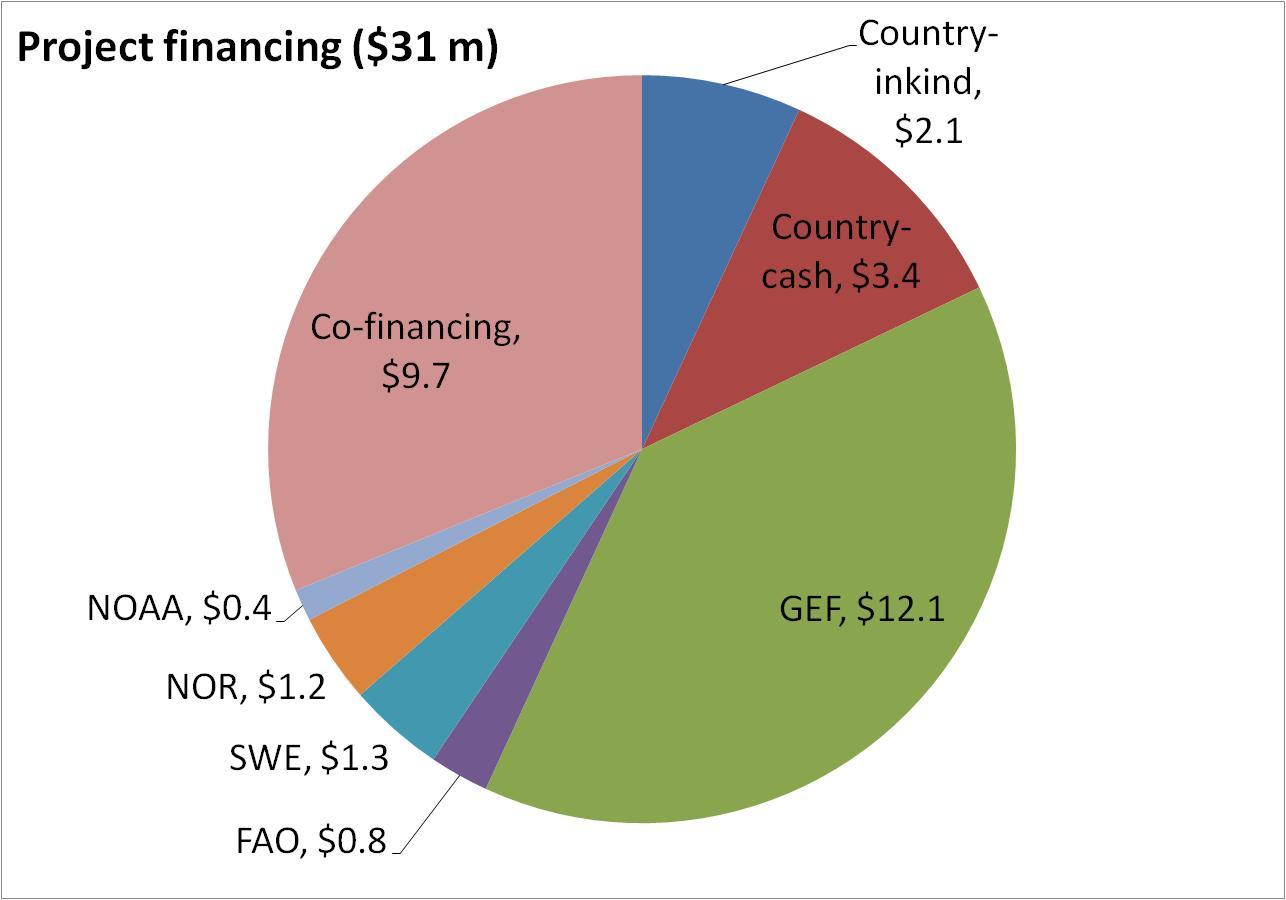
Challenges (4) Co-financing $9.7 m
Challenges - the need for partners
UNEP, UNDP, FAO, IUCN, ICRI,
GPA, IOC, *GOOS*, MFF, IOSEA,
SEAFDEC, Worldfish, BOBP-
IGO, SASP- SACEP, EASP-
COBSEA, NACA, ICSF, IOTC,
AECEN, IW Learn
ASEAN, SAARC, BIMSTEC.....
Challenges (4) - monitoring co-financing
· All activities undertaken in each country under the auspices
of the Project need to be valued and reported
Four Workshops up to September 2009: at least $40,000 in
kind from the BOBLME Countries
Project "refinements" relating to topical issues:
Project "refinements" relating to topical issues:
· Strengthening the science - management interface
· Addressing climate change
Project "refinements" relating to topical issues:
· Strengthening the science - management interface
Improving the way technical advice is delivered and
received (quality, format, process)
Project "refinements" relating to topical issues:
· Addressing climate change
Climate change is a GEF focus, Threats are "here and now"
· Identify how global predictions might manifest in the
BOB
· Identify which areas in the BOB are at risk
· Identify which habitats are barriers to climate change
generated events
· Take steps to increase resilience of communities and
ecosystems - development of tools to assist countries
respond to extreme events
Does this Inception workshop support:
· Strengthening the science - management interface
· Addressing climate change
A proposal for work in these areas (within the current
objectives and budget) could be developed by the RCU
and NCs (and NSAPs) to presented to the PSC